
Source: Roblox Creator Hub · CC BY 4.0 · View source · Code samples: MIT Imported 2026-10-03. Formatting adapted for this site.
bit32
This library provides functions to perform bitwise operations.
Number Limitations
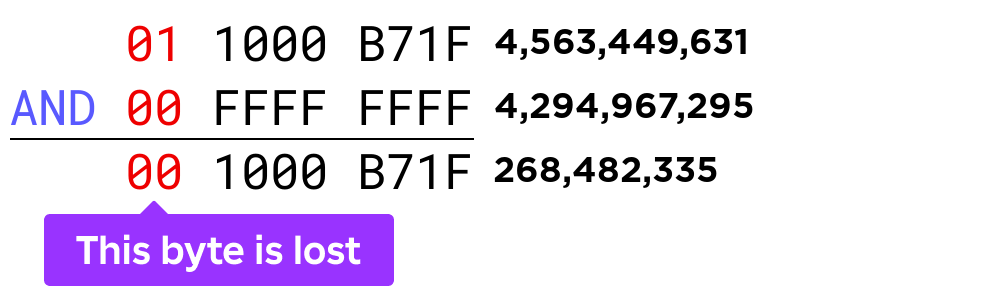
This library treats numbers as unsigned 32-bit integers; numbers will be converted to this before being used (see image below). Numbers with decimal numbers are rounded to the nearest whole number.
Functions
| Name | Type / Returns | Description |
|---|---|---|
| bit32.arshift | number | Returns a number after its bits have been arithmetically shifted to the right by a given displacement. |
| bit32.band | number | Returns the bitwise AND of all provided numbers. |
| bit32.bnot | number | Returns the bitwise negation of a given number. |
| bit32.bor | number | Returns the bitwise OR of all provided numbers. |
| bit32.btest | bool | Returns a boolean describing whether the bitwise and of its operands is different from zero. |
| bit32.bxor | number | Returns the bitwise XOR of all provided numbers. |
| bit32.byteswap | number | Returns the given number with the order of the bytes swapped. |
| bit32.countlz | number | Returns the number of consecutive zero bits in the 32-bit representation of the provided number starting from the left-most (most significant) bit. |
| bit32.countrz | number | Returns the number of consecutive zero bits in the 32-bit representation of the provided number starting from the right-most (least significant) bit. |
| bit32.extract | number | Extract a range of bits from a number and return them as an unsigned number. |
| bit32.replace | number | Return a copy of a number with a range of bits replaced by a given value. |
| bit32.lrotate | number | Returns a number after its bits have been rotated to the left by a given number of times. |
| bit32.lshift | number | Returns a number whose bits have been logically shifted to the left by a given displacement. |
| bit32.rrotate | number | Returns a number after its bits have been rotated to the right by a given number of times. |
| bit32.rshift | number | Returns a number whose bits have been logically shifted to the right by a given displacement. |
bit32.arshift
Returns the number x shifted disp bits to the right. The number disp may be any representable integer. Negative displacements shift to the left.
This shift operation is what is called arithmetic shift. Vacant bits on the left are filled with copies of the higher bit of x; vacant bits on the right are filled with zeros. In particular, displacements with absolute values higher than 31 result in zero or 0xFFFFFFFF (all original bits are shifted out).
Parameters
| Name | Type | Default | Description |
|---|---|---|---|
| x | number | The number whose bits shall be shifted. | |
| disp | number | The integer number of bits to shift by. |
Returns
| Type | Description |
|---|---|
| number | The result of arithmetically shifting x by disp bits to the right. |
bit32.band
Returns the bitwise AND of all provided numbers.
Each bit is tested against the following truth table:
| A | B | Output |
|---|---|---|
| 0 | 0 | 0 |
| 1 | 0 | 0 |
| 0 | 1 | 0 |
| 1 | 1 | 1 |

Parameters
| Name | Type | Default | Description |
|---|---|---|---|
| numbers | Tuple | The numbers to combine with bitwise AND. |
Returns
| Type | Description |
|---|---|
| number | The bitwise AND of all provided numbers. |
bit32.bnot
Returns the bitwise negation of x.

For any integer x, the following identity holds:
local x = 0xF0
assert(bit32.bnot(x) == (-1 - x) % 2^32)
Parameters
| Name | Type | Default | Description |
|---|---|---|---|
| x | number | The number to negate. |
Returns
| Type | Description |
|---|---|
| number | The bitwise negation of x. |
bit32.bor
Returns the bitwise OR of all provided numbers.
Each bit is tested against the following truth table:
| A | B | Output |
|---|---|---|
| 0 | 0 | 0 |
| 1 | 0 | 1 |
| 0 | 1 | 1 |
| 1 | 1 | 1 |

Parameters
| Name | Type | Default | Description |
|---|---|---|---|
| numbers | Tuple | The numbers to combine with bitwise OR. |
Returns
| Type | Description |
|---|---|
| number | The bitwise OR of all provided numbers. |
bit32.btest
Returns true if the bitwise AND of all its operands is different from zero, false otherwise. This is functionally equivalent to bit32.band(...) ~= 0 but returns a boolean directly without the intermediate number.
This function is useful for testing whether one or more specific bits are set in a value. For example, you can check whether a particular flag is active in a bitmask:
local flags = 0x5 -- bits 0 and 2 are set
print(bit32.btest(flags, 1)) --> true (bit 0 is set)
print(bit32.btest(flags, 2)) --> false (bit 1 is not set)
print(bit32.btest(flags, 4)) --> true (bit 2 is set)
When called with more than two arguments, all values are ANDed together before the zero-test:
print(bit32.btest(0xFF, 0x0F, 0x03)) --> true (0xFF & 0x0F & 0x03 == 0x03)Parameters
| Name | Type | Default | Description |
|---|---|---|---|
| numbers | Tuple | The numbers to test with bitwise AND. |
Returns
| Type | Description |
|---|---|
| bool | True if the bitwise AND of all operands is non-zero, false otherwise. |
bit32.bxor
Returns the bitwise XOR of all provided numbers.
Each bit is tested against the following truth table:
| A | B | Output |
|---|---|---|
| 0 | 0 | 0 |
| 1 | 0 | 1 |
| 0 | 1 | 1 |
| 1 | 1 | 0 |

Parameters
| Name | Type | Default | Description |
|---|---|---|---|
| numbers | Tuple | The numbers to combine with bitwise XOR. |
Returns
| Type | Description |
|---|---|
| number | The bitwise XOR of all provided numbers. |
bit32.byteswap
Reverses the byte order of the 32-bit unsigned integer representation of x. The four bytes are rearranged so that the most-significant byte becomes the least-significant byte and vice versa, converting between big-endian and little-endian representations.
print(bit32.byteswap(0xAABBCCDD)) --> 0xDDCCBBAA
print(bit32.byteswap(0x00000001)) --> 0x01000000
This is useful when reading or writing binary data that uses a different byte order (endianness) than expected, such as network protocols or file formats that store multi-byte integers in big-endian order.
Parameters
| Name | Type | Default | Description |
|---|---|---|---|
| x | number | The number whose bytes to swap. |
Returns
| Type | Description |
|---|---|
| number | The number with its byte order reversed. |
bit32.countlz
Returns the number of consecutive zero bits in the 32-bit representation of the provided number starting from the left-most (most significant) bit. Returns 32 if the provided number is zero.
Parameters
| Name | Type | Default | Description |
|---|---|---|---|
| n | number | The number to count leading zeros in. |
Returns
| Type | Description |
|---|---|
| number | The count of consecutive zero bits from the most significant bit, or 32 if n is zero. |
bit32.countrz
Returns the number of consecutive zero bits in the 32-bit representation of the provided number starting from the right-most (least significant) bit. Returns 32 if the provided number is zero.
Parameters
| Name | Type | Default | Description |
|---|---|---|---|
| n | number | The number to count trailing zeros in. |
Returns
| Type | Description |
|---|---|
| number | The count of consecutive zero bits from the least significant bit, or 32 if n is zero. |
bit32.extract
Returns the unsigned number formed by the bits field to field + width - 1 from n. Bits are numbered from 0 (least significant) to 31 (most significant). All accessed bits must be in the range [0, 31]. The default for width is 1.
Parameters
| Name | Type | Default | Description |
|---|---|---|---|
| n | number | The number to extract bits from. | |
| field | number | The zero-based position of the least significant bit to extract. | |
| width | number | 1 | The number of bits to extract. |
Returns
| Type | Description |
|---|---|
| number | The unsigned number formed by the extracted bit range. |
bit32.replace
Returns a copy of n with the bits field to field + width - 1 replaced by the value v. See bit32.extract() for details about field and width.
Parameters
| Name | Type | Default | Description |
|---|---|---|---|
| n | number | The number in which to replace bits. | |
| v | number | The replacement value to insert into the bit range. | |
| field | number | The zero-based position of the least significant bit to replace. | |
| width | number | 1 | The number of bits to replace. |
Returns
| Type | Description |
|---|---|
| number | A copy of n with the specified bit range replaced by v. |
bit32.lrotate
Returns the number x rotated disp bits to the left. The number disp may be any representable integer. For any valid displacement, the following identity holds:
local x, disp = 0xF0, 35
assert(bit32.lrotate(x, disp) == bit32.lrotate(x, disp % 32))
In particular, negative displacements rotate to the right.
Parameters
| Name | Type | Default | Description |
|---|---|---|---|
| x | number | The number whose bits to rotate. | |
| disp | number | The number of bit positions to rotate left. |
Returns
| Type | Description |
|---|---|
| number | The result of rotating x left by disp bits. |
bit32.lshift
Returns the number x shifted disp bits to the left. The number disp may be any representable integer. Negative displacements shift to the right. In any direction, vacant bits are filled with zeros. In particular, displacements with absolute values higher than 31 result in zero (all bits are shifted out).
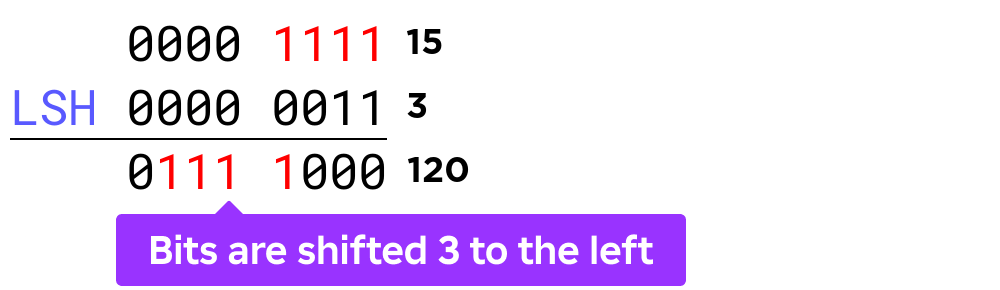
For positive displacements, the following equality holds:
local b, disp = 0xF0, 3
assert(bit32.lshift(b, disp) == (b * 2^disp) % 2^32)
Parameters
| Name | Type | Default | Description |
|---|---|---|---|
| x | number | The number whose bits to shift. | |
| disp | number | The number of bit positions to shift left. |
Returns
| Type | Description |
|---|---|
| number | The result of logically shifting x left by disp bits. |
bit32.rrotate
Returns the number x rotated disp bits to the right. The number disp may be any representable integer.
For any valid displacement, the following identity holds:
local x, disp = 0xF0, 35
assert(bit32.rrotate(x, disp) == bit32.rrotate(x , disp % 32))
In particular, negative displacements rotate to the left.
Parameters
| Name | Type | Default | Description |
|---|---|---|---|
| x | number | The number whose bits to rotate. | |
| disp | number | The number of bit positions to rotate right. |
Returns
| Type | Description |
|---|---|
| number | The result of rotating x right by disp bits. |
bit32.rshift
Returns the number x shifted disp bits to the right. The number disp may be any representable integer. Negative displacements shift to the left. In any direction, vacant bits are filled with zeros. In particular, displacements with absolute values higher than 31 result in zero (all bits are shifted out).
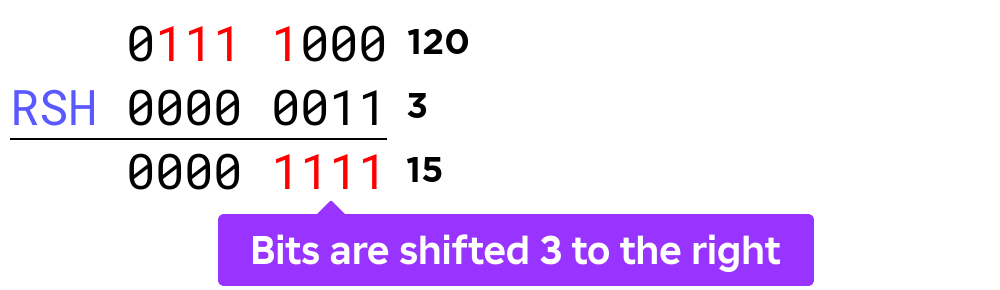
For positive displacements, the following equality holds:
local b, disp = 0xF00, 3
assert(bit32.rshift(b, disp) == (b % 2^32 / 2^disp) // 1)
This shift operation is what is called logical shift.
Parameters
| Name | Type | Default | Description |
|---|---|---|---|
| x | number | The number whose bits to shift. | |
| disp | number | The number of bit positions to shift right. |
Returns
| Type | Description |
|---|---|
| number | The result of logically shifting x right by disp bits. |