
Source: Roblox Creator Hub · CC BY 4.0 · View source · Code samples: MIT Imported 2026-10-03. Formatting adapted for this site.
NPC kit
Note
The content of this project and documentation can be used under Roblox's Limited Use License.
NPCs (non-player characters) can add a lot of depth to a game. All of the following NPCs can be visually customized, their behavior modified, and the zombie/soldiers can even defend an area by attacking players or other characters using a tag system to set behavior.
To use an NPC in your game:
Select one of the following NPC kits:

Drooling Zombie

Soldiers

RO-01 Robots

NP-C 9000 Robots
On the NPC's item page, click the green Get button and confirm the transaction.
In Studio, open the Toolbox.
Select your toolbox Inventory section.
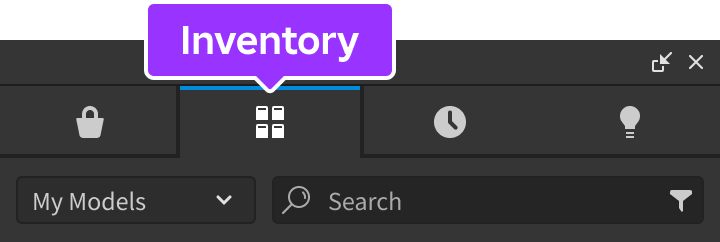
Locate the NPC and click it to add it into the place.
Character structure
Each NPC model typically contains the following objects:
| Object name or [Type] | Type | Description |
|---|---|---|
| Animations | [`Folder`](/docs/folder) | Contains [`Animations`](/docs/animation), such as an `AttackAnimation` or `DeathAnimation`. |
| Initial Poses | [`Folder`](/docs/folder) | Contains posing information. |
| [Animate](#animate) | [`Script`](/docs/script) | Loads and plays animations on the character rig. See [Animate](#animate) for more details. |
| [Accessory] | [`Accessory`](/docs/accessory) | One of possibly multiple [`Accessories`](/docs/accessory) for the NPC such as hats, weapons, etc. |
| Health | [`Script`](/docs/script) | Typically regenerates the [`Humanoid`](/docs/humanoid) health over time. Disabling this will prevent the character from regenerating health. |
| Humanoid | [`Humanoid`](/docs/humanoid) | Manages [`Humanoid`](/docs/humanoid) related properties, such as [`Humanoid.Health`](/docs/humanoid#humanoid-health), [`Humanoid.WalkSpeed`](/docs/humanoid#humanoid-walkspeed), [`Humanoid.DisplayDistanceType`](/docs/humanoid#humanoid-displaydistancetype), etc. |
| NPC | [`Script`](/docs/script) | Defines character-specific behaviors such as roaming, attacking, etc. Parents the following objects: Maid ( Ragdoll ( |
| RbxNpcSounds | [`Script`](/docs/script) | Defines and manages behavior related to character sound effects like running, dying, etc. |
| [BodyParts](#bodyparts) | [`BasePart`](/docs/basepart) | Various character body parts attached to the HumanoidRootPart or neighboring body parts through Motor6D or constraint objects. See [BodyParts](#bodyparts) for more details. |
| HumanoidRootPart | [`BasePart`](/docs/basepart) | A special invisible part that's considered the root of the rig; this is also the `PrimaryPart` of the character's [`Model`](/docs/model). |
| [Configuration](#configuration) | [`Configuration`](/docs/configuration) | Contains value objects which tune various behaviors. See [Configuration](#configuration) for more details. |
Note
Square brackets [] refer to the object in general and the name doesn't matter. For example, [Model] refers to the weapon's Model and you can rename it to whatever makes sense.
Design notes
When using the NPC kit, keep in mind the following design notes:
The visual appearance of an NPC can be customized by adding/modifying various [BodyParts] objects and by adding
Accessoryobjects.The Soldiers, Drooling Zombie, and NP-C 9000 Robots use Rthro as the base of their rig. However, the RO-01 Robots use a modified Rthro base that adds thruster parts connected to the UpperTorso using
WeldConstraints. Using simple joints in this way lets you include extra geometry for your characters without changing the original base rig.At a basic level, NPC animations can be customized by modifying the
AnimationIdof existing Animation objects within the Animate script poses, or those within the Animations folder. Such a change is essentially an asset swap - to change the finer details, you can create custom copies of existing animations, and to play animations under different conditions, you can edit the Animate or NPC scripts directly. For more information, see Animation.
Animate
The Animate Script in the NPC Model handles animation related configurations and contains the following objects:
| Object name or [Type] | Type | Description |
|---|---|---|
| ScaleDampeningPercent | [`NumberValue`](/docs/numbervalue) | Defines how animation speeds are modified as the character is scaled (less than 1 implies animation playback scales inversely as a character is scaled). |
| PlayEmote | [`BindableFunction`](/docs/bindablefunction) | This can be invoked by other scripts in order to force the assumption of a pose. |
| [Pose] | [`StringValue`](/docs/stringvalue) | Reference to a playable animation category such as idle, jump, walk, etc. This object can parent any number of [`Animations`](/docs/animation). These [`Animations`](/docs/animation) parent a **Weight** ([`NumberValue`](/docs/numbervalue)) that prioritizes one of multiple animations to play while the pose is assumed; typically used to add variety to idle and dance poses. |
BodyParts
The BodyPart BasePart in the NPC Model represent the various character body parts and contains the following objects:
| Object name or [Type] | Type | Description |
|---|---|---|
| AvatarPartScaleType | [`StringValue`](/docs/stringvalue) | Determines how the part will be scaled; values can be **Classic**, **ProportionsNormal**, or **ProportionsSlender**. |
| OriginalSize | [`Vector3Value`](/docs/vector3value) | Determines the size of the part when the character scaling is 1. |
| [Attachment] | [`Attachment`](/docs/attachment) | Defines a point relative to the individual part which scripts, effects, and objects such as a [`Tool`](/docs/tool) or [`Accessory`](/docs/accessory) may utilize during positioning. |
| [Motor6D] | [`Motor6D`](/docs/motor6d) | An animated joint between two body parts. Note that [`Animator`](/docs/animator) depends on the name of [`Motor6Ds`](/docs/motor6d) to be consistent with that of the [`Motor6Ds`](/docs/motor6d) used when an animation was created, so avoid renaming this object. |
| [Joint] | [`WeldConstraint`](/docs/weldconstraint), [`Constraint`](/docs/constraint), [`JointInstance`](/docs/jointinstance) | A non-animated joint between two body parts. |
| [Sound] | [`Sound`](/docs/sound) | Commonly found in the head or `HumanoidRootPart`; plays sounds from within the rig as controlled by the `RbxNpcSounds` script. |
Configuration
Each NPC includes a Configuration object within its hierarchy which acts as a container of value objects. These are used by the NPC script to tune various behaviors. Unless otherwise specified, these apply to all of the characters.
| Object name or [Type] | Type | Description |
|---|---|---|
| DestroyOnDeath | [`BoolValue`](/docs/boolvalue) | Causes the entire NPC to be destroyed shortly after it dies. Disable this for ragdolls to be persistent. |
| PatrolEnabled | [`BoolValue`](/docs/boolvalue) | Causes the NPC to wander in an area around its starting position. |
| PatrolRadius | [`NumberValue`](/docs/numbervalue) | Defines the maximum distance an NPC will wander from its starting position, assuming **PatrolEnabled** is true. |
| RagdollEnabled | [`BoolValue`](/docs/boolvalue) | Causes the NPC to go limp when it dies, instead of breaking apart. |
| AttackDamage | [`NumberValue`](/docs/numbervalue) | Defines how much health is lost by a victim when attacked by the NPC. This applies for Zombie and Soldier kits only. |
| AttackDelay | [`NumberValue`](/docs/numbervalue) | Defines the minimum number of seconds between shots. This applies for Soldier kits only. |
| AttackMode | [`NumberValue`](/docs/numbervalue) | Specifies what the soldier will attack, based on the [tagging system](#assign-tags). This applies for Soldier kits only. |
| AttackRadius | [`NumberValue`](/docs/numbervalue) | Defines the maximum distance the NPC must be from a potential victim before it attempts to attack. This applies for Zombie and Soldier kits only. |
| ClipCapacity | [`NumberValue`](/docs/numbervalue) | Defines how many bullets the soldier can fire before needing to reload. This applies for Soldier kits only. |
| ReloadDelay | [`NumberValue`](/docs/numbervalue) | Defines how many seconds must pass before the soldier's weapon clip is reloaded. This applies for Soldier kits only. |
Assign tags
The NPC script uses CollectionService tags to manage aggression toward other characters and players. Various tags from the following table can be assigned as follows:
To assign tag(s) to another NPC, assign them to the NPC's top-level
Modelusing the Tags section of its properties.To assign a tag to a
Playercharacter, you can add aScriptto StarterCharacterScripts with aCollectionService:AddTag()call. For example:local CollectionService = game:GetService("CollectionService") CollectionService:AddTag(script.Parent, "SoldierEnemy")
| Tag | Purpose |
|---|---|
| **SoldierEnemy** or **SoldierFriend** | Determines if a soldier, based on its **AttackMode** configuration value, should attack another character. When the soldier's **AttackMode** is set to `1`, other characters must be tagged with **SoldierEnemy** to be considered attackable. When the soldier's **AttackMode** is set to `2`, all objects without the **SoldierFriend** tag are considered attackable. When the soldier's **AttackMode** is set to `3`, these tags are ignored entirely and the soldier will attack all characters. |
| **ZombieFriend** | This tag is used by the zombie to determine whether it should not attack a character. When applied, the zombie becomes docile toward the tagged character. |