
Source: Roblox Creator Hub · CC BY 4.0 · View source · Code samples: MIT Imported 2026-10-03. Formatting adapted for this site.
Customize bubble chat
With TextChatService, you can use bubble chat to display customizable speech chat bubbles above user avatars and NPCs. Bubble chat can make your game more visually immersive and help users easily identify messages and their speakers in a contextually relevant manner. This feature is especially useful for games where users need to focus on the content in the meantime communicating with others in a less obtrusive way.
Enable bubble chat
To enable bubble chat in your game:
In the Explorer window, select
BubbleChatConfigurationunderTextChatService.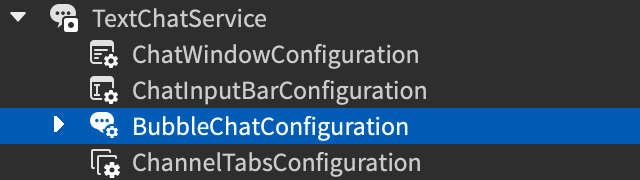
In the Properties window, check the
BubbleChatConfiguration.Enabledcheckbox.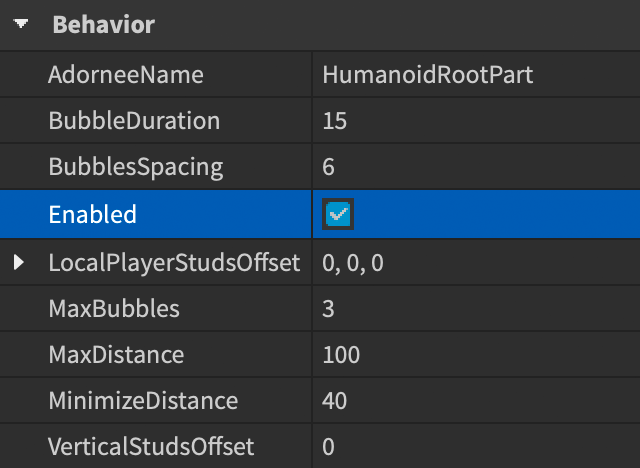
Bubble customization
After enabling bubble chat, you can customize the appearance and behavior of your chat bubbles to match your game's theme. Use the Properties window of BubbleChatConfiguration for basic changes like text color and spacing, or implement advanced customization for bubble background images and other visual adjustments.
Alternatively, add a LocalScript in StarterPlayerScripts with all your customization settings. This allows the engine to apply your customizations during runtime, overriding the settings in Studio. It's useful for adding special effects to chat bubbles when users trigger certain events or conditions.
Basic customization
The following table shows common bubble chat customization properties. For a full list of customization properties, see BubbleChatConfiguration.
Appearance
| Property | Description | Default |
|---|---|---|
| [`BackgroundColor3`](/docs/bubblechatconfiguration#bubblechatconfiguration-backgroundcolor3) | Background color of bubbles in [`Color3`](/docs/color3). | `[250, 250, 250]` |
| [`FontFace`](/docs/bubblechatconfiguration#bubblechatconfiguration-fontface) | [`Font`](/docs/font) of the bubble text. | [`BuilderSansMedium`](/docs/enum-font#buildersansmedium) |
| [`TextColor3`](/docs/bubblechatconfiguration#bubblechatconfiguration-textcolor3) | Color of bubble text in [`Color3`](/docs/color3). | `[57, 59, 61]` |
| [`TextSize`](/docs/bubblechatconfiguration#bubblechatconfiguration-textsize) | Size of bubble text. | `16` |
Behavior
| Property | Description | Default |
|---|---|---|
| [`Enabled`](/docs/bubblechatconfiguration#bubblechatconfiguration-enabled) | Indicating whether bubble chat is enabled in the game. | `true` (checked) |
| [`AdorneeName`](/docs/bubblechatconfiguration#bubblechatconfiguration-adorneename) | String name of the body part or [`Attachment`](/docs/attachment) that bubbles attach to; if multiple instances of the same name exist, the system attaches to the first instance found. | `HumanoidRootPart` |
| [`BubbleDuration`](/docs/bubblechatconfiguration#bubblechatconfiguration-bubbleduration) | Time before a bubble fades out, in seconds. | `30` |
| [`BubblesSpacing`](/docs/bubblechatconfiguration#bubblechatconfiguration-bubblesspacing) | Vertical space between stacked bubbles, in pixels. | `6` |
| [`LocalPlayerStudsOffset`](/docs/bubblechatconfiguration#bubblechatconfiguration-localplayerstudsoffset) | If adorned to the local player, the offset of bubbles in studs from their adornee, relative to the camera orientation ([`Vector3`](/docs/vector3)). | `(0, 0, 0)` |
| [`MaxDistance`](/docs/bubblechatconfiguration#bubblechatconfiguration-maxdistance) | Maximum distance from the camera that bubbles are shown. | `100` |
| [`MinimizeDistance`](/docs/bubblechatconfiguration#bubblechatconfiguration-minimizedistance) | Distance from the camera when bubbles turn into a single bubble with an ellipsis (**⋯**) to indicate chatter. | `40` |
| [`VerticalStudsOffset`](/docs/bubblechatconfiguration#bubblechatconfiguration-verticalstudsoffset) | Extra space between bubbles and their adornee, in studs. | `0` |
| [`MaxBubbles`](/docs/bubblechatconfiguration#bubblechatconfiguration-maxbubbles) | Maximum number of bubbles displayed before older bubbles disappear. | `3` |
Advanced customization
For advanced customization of your bubble, add UI objects representing certain aspects of the bubble appearance as children under BubbleChatConfiguration, including:
ImageLabelfor background image settings.UIGradientfor background gradient settings.UICornerfor the corner shape of bubbles.UIPaddingfor the padding space between the text and bubble edges, relative to the parent's normal size.
After adding these objects, you can modify properties of these objects applicable to chat bubbles for advanced bubble customization. The following example LocalScript adds a background image and sharp corners to bubbles:
local TextChatService = game:GetService("TextChatService")

local bubbleChatConfiguration = TextChatService.BubbleChatConfiguration
bubbleChatConfiguration.TailVisible = false
bubbleChatConfiguration.TextColor3 = Color3.fromRGB(220, 50, 50)
bubbleChatConfiguration.FontFace = Font.fromEnum(Enum.Font.LuckiestGuy)

local bubbleUICorner = bubbleChatConfiguration:FindFirstChildOfClass("UICorner")
if not bubbleUICorner then
	bubbleUICorner = Instance.new("UICorner")
	bubbleUICorner.Parent = bubbleChatConfiguration
end
bubbleUICorner.CornerRadius = UDim.new(0, 0)

local bubbleUIPadding = bubbleChatConfiguration:FindFirstChildOfClass("UIPadding")
if not bubbleUIPadding then
	bubbleUIPadding = Instance.new("UIPadding")
	bubbleUIPadding.Parent = bubbleChatConfiguration
end
bubbleUIPadding.PaddingTop = UDim.new(0, 20)
bubbleUIPadding.PaddingRight = UDim.new(0, 10)
bubbleUIPadding.PaddingBottom = UDim.new(0, 15)
bubbleUIPadding.PaddingLeft = UDim.new(0, 10)

local bubbleImageLabel = bubbleChatConfiguration:FindFirstChildOfClass("ImageLabel")
if not bubbleImageLabel then
	bubbleImageLabel = Instance.new("ImageLabel")
	bubbleImageLabel.Parent = bubbleChatConfiguration
end
bubbleImageLabel.Image = "rbxassetid://109157529833093"
bubbleImageLabel.ScaleType = Enum.ScaleType.Slice
bubbleImageLabel.SliceCenter = Rect.new(40, 40, 320, 120)
bubbleImageLabel.SliceScale = 0.5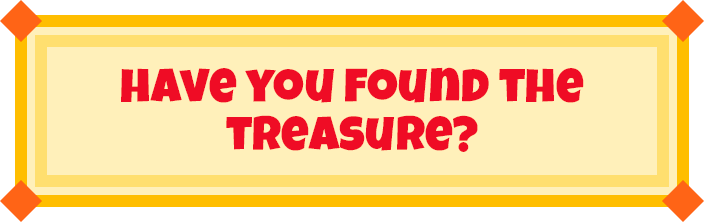
The following tables outline the available GuiObject and appearance modifier children along with their valid customization properties:
ImageLabel
| Property | Description | Default |
|---|---|---|
| [`Image`](/docs/imagelabel#imagelabel-image) | Asset ID of the bubble background image. | |
| [`ImageColor3`](/docs/imagelabel#imagelabel-imagecolor3) | Color tint of the bubble background image in [`Color3`](/docs/color3). | `[255, 255, 255]` |
| [`ImageRectOffset`](/docs/imagelabel#imagelabel-imagerectoffset) | Offset of the image area to be displayed from the top-left in pixels. | `(0, 0)` |
| [`ImageRectSize`](/docs/imagelabel#imagelabel-imagerectsize) | Size of the image area to be displayed in pixels. To display the entire image, set either dimension to `0`. | `(0, 0)` |
| [`ScaleType`](/docs/imagelabel#imagelabel-scaletype) | The scale type for rendering the image when its size is different from the absolute size of the bubble. | [`Stretch`](/docs/enum-scaletype) |
| [`SliceCenter`](/docs/imagelabel#imagelabel-slicecenter) | Slice boundaries of the image if the image is a 9-sliced image. Only applicable when you set [`ScaleType`](/docs/imagelabel#imagelabel-scaletype) as [`Slice`](/docs/enum-scaletype). | `(0, 0, 0, 0)` |
| [`SliceScale`](/docs/imagelabel#imagelabel-slicescale) | Scale ratio of slice edges if the image is a 9-sliced image. Only applicable when you set [`ScaleType`](/docs/imagelabel#imagelabel-scaletype) as [`Slice`](/docs/enum-scaletype). | `1` |
| [`TileSize`](/docs/imagelabel#imagelabel-tilesize) | Tiling size of the image. Only applicable when you set [`ScaleType`](/docs/imagelabel#imagelabel-scaletype) as [`Tile`](/docs/enum-scaletype). | `(1, 0, 1, 0)` |
UIGradient
| Property | Description | Default |
|---|---|---|
| [`Enabled`](/docs/uigradient#uigradient-enabled) | Indicating whether the bubble background gradient is enabled. | `false` (unchecked) |
| [`Color`](/docs/uigradient#uigradient-color) | Color of the background gradient. | `[250, 250, 250]` |
| [`Offset`](/docs/uigradient#uigradient-offset) | Scalar translation of the gradient from the center of the bubble. | `(0, 0)` |
| [`Rotation`](/docs/uigradient#uigradient-rotation) | Clockwise rotation, in degrees, of the gradient starts from left to right. | `0` |
| [`Transparency`](/docs/uigradient#uigradient-transparency) | Transparency of the background gradient. | `(1, 0)` |
UICorner
| Property | Description | Default |
|---|---|---|
| [`CornerRadius`](/docs/uicorner#uicorner-cornerradius) | Radius of the bubble corner shape in pixels. | `(0, 12)` |
UIPadding
| Property | Description | Default |
|---|---|---|
| [`PaddingBottom`](/docs/uipadding#uipadding-paddingbottom) | Padding on the bottom. | [`UDim.new(0,8)`](/docs/udim#udim-new) |
| [`PaddingLeft`](/docs/uipadding#uipadding-paddingleft) | Padding on the left. | [`UDim.new(0,8)`](/docs/udim#udim-new) |
| [`PaddingRight`](/docs/uipadding#uipadding-paddingright) | Padding on the right. | [`UDim.new(0,8)`](/docs/udim#udim-new) |
| [`PaddingTop`](/docs/uipadding#uipadding-paddingtop) | Padding on the top. | [`UDim.new(0,8)`](/docs/udim#udim-new) |
Per-bubble customization
You can individually style and modify chat bubble behaviors based on specific conditions in order to override your general settings. For example, you can use chat bubbles to differentiate NPCs and users, highlight critical health status, and apply special effects to messages with pre-defined keywords.
To set per-bubble customization, add a client-side LocalScript using BubbleChatMessageProperties, which overrides matching properties of BubbleChatConfiguration, and the TextChatService.OnBubbleAdded callback to specify how to customize each bubble. The callback supplies you with the TextChatMessage property as well as the adornee, so you can apply the customization based on attributes associated with users, the chat text content, user character properties, and any special conditions you want to define.
The following basic customization properties are available for per-bubble customization:
| Property | Description | Default |
|---|---|---|
| [`BackgroundColor3`](/docs/bubblechatconfiguration#bubblechatconfiguration-backgroundcolor3) | Background color of bubbles in [`Color3`](/docs/color3). | `(250, 250, 250)` |
| [`BackgroundTransparency`](/docs/bubblechatconfiguration#bubblechatconfiguration-backgroundtransparency) | Background transparency of bubbles. | `0.1` |
| [`FontFace`](/docs/bubblechatconfiguration#bubblechatconfiguration-fontface) | [`Font`](/docs/font) of the bubble text. | [`BuilderSansMedium`](/docs/enum-font#buildersansmedium) |
| [`TextColor3`](/docs/bubblechatconfiguration#bubblechatconfiguration-textcolor3) | Color of bubble text in [`Color3`](/docs/color3). | `[57, 59, 61]` |
| [`TextSize`](/docs/bubblechatconfiguration#bubblechatconfiguration-textsize) | Size of bubble text. | `16` |
The following example adds special appearance to VIP users' chat bubbles by checking if a chat message sender has the IsVIP attribute:
local TextChatService = game:GetService("TextChatService")
local Players = game:GetService("Players")

-- Event handler for when a new chat bubble is added to the game
TextChatService.OnBubbleAdded = function(message: TextChatMessage, adornee: Instance)
	-- Check if the chat message has a TextSource (sender) associated with it
	if message.TextSource then
		-- Create a new BubbleChatMessageProperties instance to customize the chat bubble
		local bubbleProperties = Instance.new("BubbleChatMessageProperties")

		-- Get the user who sent the chat message based on their UserId
		local player = Players:GetPlayerByUserId(message.TextSource.UserId)

		if player:GetAttribute("IsVIP") then
			-- If the player is a VIP, customize the chat bubble properties
			bubbleProperties.TextColor3 = Color3.fromHex("#F5CD30")
			bubbleProperties.BackgroundColor3 = Color3.fromRGB(25, 27, 29)
			bubbleProperties.FontFace = Font.fromEnum(Enum.Font.PermanentMarker)
		end
		return bubbleProperties
	end
end
All advanced customization options are available for per-bubble customization. Similar to advanced customization for general bubbles, add instances that you want to customize as children of BubbleChatMessageProperties. The following example adds a special gradient effect along with other properties to chat bubbles of users with low health status by checking the Humanoid.Health property of chat message senders' characters:
local TextChatService = game:GetService("TextChatService")
local Players = game:GetService("Players")

-- Event handler for when a new chat bubble is added to the game
TextChatService.OnBubbleAdded = function(message: TextChatMessage, adornee: Instance)
	-- Check if the chat message has a TextSource (sender) associated with it
	if message.TextSource then
		-- Get the user who sent the chat message by using their UserId
		local player = Players:GetPlayerByUserId(message.TextSource.UserId)

		-- Find the humanoid in the user's character
		local humanoid = player.Character:FindFirstChildWhichIsA("Humanoid")

		if humanoid and humanoid.Health < 25 then
			-- Create a new BubbleChatMessageProperties instance to customize the chat bubble
			local bubbleProperties :BubbleChatMessageProperties = Instance.new("BubbleChatMessageProperties")

			-- Customize the chat bubble properties for low health condition
			bubbleProperties.BackgroundColor3 = Color3.fromRGB(245, 245, 245)
			bubbleProperties.TextColor3 = Color3.fromRGB(234, 51, 96)
			bubbleProperties.TextSize = 20
			bubbleProperties.FontFace = Font.fromEnum(Enum.Font.DenkOne)

			-- Add a UIGradient as a child to customize the gradient
			local uiGradient : UIGradient = Instance.new("UIGradient")
			uiGradient.Color = ColorSequence.new(Color3.fromRGB(110, 4, 0), Color3.fromRGB(0, 0, 0))
			uiGradient.Rotation = 90
			uiGradient.Parent = bubbleProperties

			return bubbleProperties
		end
	end
end
Manually display bubbles
You might want to display a chat bubble when players haven't sent a message, such as with NPCs. Use the TextChatService:DisplayBubble method to manually display a chat bubble.
Customization of these bubbles is the same as the customization of the bubbles that are automatically displayed when Players send messages through TextChannels using the TextChatService.OnBubbleAdded callback.
Note
To generate speech or other text using an LLM, see the TextGenerator class.
NPC bubbles
Display chat bubbles for non-player characters (NPCs) by calling TextChatService:DisplayBubble(character, message), with the NPC character and the message as parameters. These bubbles are customizable using the TextChatService.OnBubbleAdded callback just like any other chat bubble.
TextChatService:DisplayBubble() only works on client-side scripts, so be sure to use a Script with RunContext set to RunContext.Client, or a LocalScript in an appropriate container, such as StarterPlayerScripts. If you attach a ProximityPrompt to an NPC, a script for displaying a chat bubble might look like this:
local TextChatService = game:GetService("TextChatService")
local Workspace = game:GetService("Workspace")

local prompt = Workspace.SomeNPC.ProximityPrompt
local head = prompt.Parent:WaitForChild("Head")

prompt.Triggered:Connect(function()
	TextChatService:DisplayBubble(head, "Hello world!")
end)